How to choose a padel racket — and what the overall score can't tell you
17 min readSources ↓
The short answer. Round rackets are more forgiving, diamonds hit harder, teardrops sit between the two. A lighter racket is easier to move. A low balance favours control, a high balance favours power. Every buying guide says this, and broadly it holds.
It just won't help you choose between two specific rackets. Here is why, and what to look at instead.
One overall score. Two different games.
8.6 = 8.6
Now look at the profile.
Power
Control
Rebound
Manoeuvrability
Sweet spot
Ratings: Padelful · How they are compiled ↗Checked 10 October 2026
In this guide
Two rackets with exactly the same score
Two rackets, both rated 8.6 by Padelful.
Adidas Metalbone CTRL 3.4 2025
power 7.8 · control 8.7 · rebound 9.5 · manoeuvrability 7.8 · sweet spot 9.2
Round, soft core, 345–360 grams.
Head Coello Pro 2026
power 9.9 · control 9.9 · rebound 7.4 · manoeuvrability 7.9 · sweet spot 8.1
Diamond, hard core, 370 grams.
Not close. The same number.
And they are nothing like the same racket. The Adidas is built to forgive: a wide sweet spot, a ball that comes off the face easily, a soft core. The Head is built to finish points, with top marks for power and control, but it wants a committed swing before it gives you anything, and its own review notes that defence needs full preparation and that it can be hard on the elbow or wrist.
If you are six months into the sport, one of these will flatter your game and the other will punish it. The 8.6 cannot tell you which.
What an average can and cannot carry
It is tempting to assume power and control trade off against each other, so that averaging punishes specialists. Our own example says otherwise: the Coello Pro scores 9.9 in both. The five attributes are rated independently, and a racket can be strong in several at once.
What the average actually does is simpler. It compresses five numbers into one, and compression loses information. Two rackets with almost nothing in common can land on the same figure.
Padelful is explicit about the method on its own page: the public rating is the equal-weighted average of the five attributes, and in mathematical terms it is the match score of a balanced intermediate player.
So the score is not meaningless and it is not aimed at somebody else. It is a fair summary of how good a racket is, judged on behalf of an average player. It simply answers a different question from the one you are asking.
How good is this racket, and is this racket right for me, are two separate questions. The rest of this guide is about the second one.
Start with what you actually do on court
Before shape, weight or balance, three questions decide more than any specification.
- 1
How long have you been playing? Not as a label, but concretely: is your contact point repeatable yet? A racket that rewards a clean, committed swing is only an advantage once you produce one reliably. Until then it mostly punishes you.
- 2
Where do you spend your time? Padel splits roughly into the back of the court, where you lift, defend and play off the glass, and the net, where you volley and finish. Most recreational players spend far more time at the back than they imagine. The racket that suits that work is not the one that suits highlight smashes.
- 3
How often do you play? Once a week and four times a week are different sports as far as your arm is concerned. Total weight that feels fine in a shop behaves differently in the second hour of the second match of the week.
Answer those three honestly and most of the rest of this guide becomes a process of elimination.
Shape: round, teardrop, diamond
Shape is the first thing anyone tells you about a racket, and it is a reasonable starting signal.
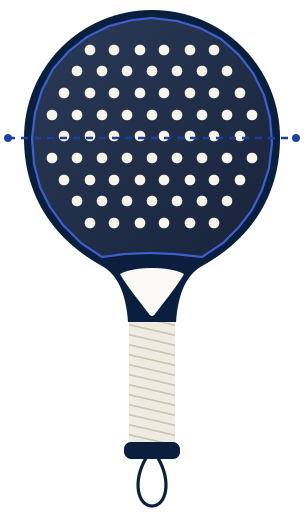
Round. The widest part of the face sits lower, which generally puts the weight closer to your hand. These rackets tend to be easier to swing and more tolerant of an imperfect contact point. The usual recommendation for players still building technique, and for anyone who prefers to place the ball rather than hit through it.
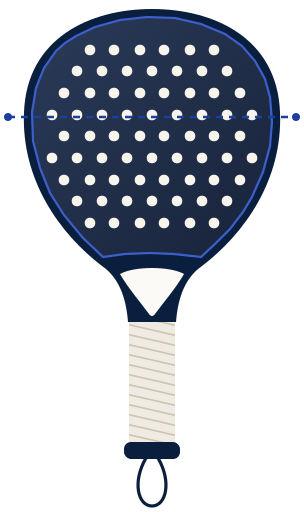
Teardrop. The mass sits a little higher and the face narrows towards the top. The common compromise: more help on attacking shots than a round frame, without the demands of a diamond. Most all-round recreational rackets live here.
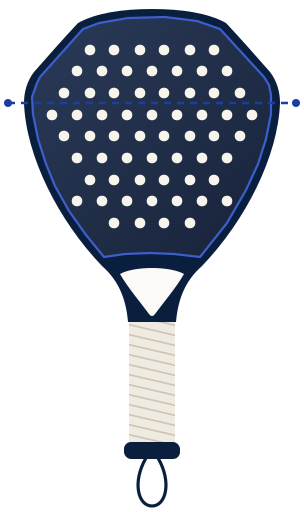
Diamond. The widest point sits high in the head, which concentrates mass away from your hand. That gives leverage on overheads and punched volleys, and asks for timing and preparation in return. Built for players who attack first.
And hybrid? Here the labels get loose. Bullpadel, Nox, Kuikma and others use hybrid for frames that borrow from more than one shape, and there is no agreed definition — some sit nearer round, some nearer teardrop or diamond. The name on its own tells you very little, so go to the balance and the ratings instead.
What shape does not settle
The pattern above is a tendency, not a mechanism. Two findings from the Valencia laboratory are worth knowing before you treat the outline as a verdict.
First, when researchers used a robot to locate the sweet spot on 225 rackets, the position of that spot showed no significant relationship with shape. The shape comparison covered 93 of those rackets, grouped as round, teardrop and diamond.
Second, and more usefully, the authors point out that shape does not set balance on its own. The materials, the shape of the heart and the mass sitting in it all move the balance too. Their conclusion is blunt: shape matters less in choosing a racket than the physical properties do.
So read shape as a statement of intent from the manufacturer. Then check the numbers underneath it.
Weight: why grams alone settle nothing
When the same laboratory weighed 137 rackets, they ran from 316 to 387 grams, averaging 363. Most rackets you will meet sit in a fairly narrow band around the middle of that.
Two things about that number are worth more than the number itself.
It is often a range, not a figure. Some manufacturers publish a model's weight as a span up to 20 grams wide. Two examples of the same model can therefore differ by more than two different models appear to differ on paper.
It changes after purchase. An overgrip adds mass at the handle and a frame protector adds it at the head. The researchers list both as factors that interfered with their own measurements. A used racket arrives with whatever the previous owner chose.
And weight on its own does not tell you how a racket handles. A 370-gram racket with its mass low can be easier to swing than a 360-gram racket with mass in the head. Handling comes from weight, balance and how the mass is distributed, taken together — which is why the next section matters more than this one.
So what counts as light or heavy?
Published boundaries vary more than you would expect. One retailer's guide calls 360 grams heavy; another calls the same figure medium. Worth knowing before you take any single classification seriously.
The measured distribution is a steadier anchor. Across those 137 rackets the range ran 316 to 387 grams, averaging 363, with most models clustered near the middle. So in round terms: under about 350 grams is the lighter end of the adult market, the bulk of it sits somewhere around 355 to 370, and above roughly 375 you are into heavier territory.
These are reference points, not rules tied to ability. A well-balanced 370-gram racket can be easier to handle than a lighter one carrying its mass in the head. And the figure on the box may not include the grip and protector fitted to the racket you actually play with.
Balance: why a heavier racket can feel lighter
The balance point is where a racket balances when you measure from the end of the handle. Across those 137 rackets it ran from 246 to 283 mm, averaging 265.
The number is measured from the end of the handle towards the head, so a larger figure means the mass sits further from your hand. Picture two rackets of identical weight, one balancing at 255 mm and the other at 275 mm — both ordinary figures. The second carries its centre of mass further out, which generally makes it more demanding to accelerate and to redirect. Nothing on the scales tells you that.
Same weight. Different balance.
Schematic
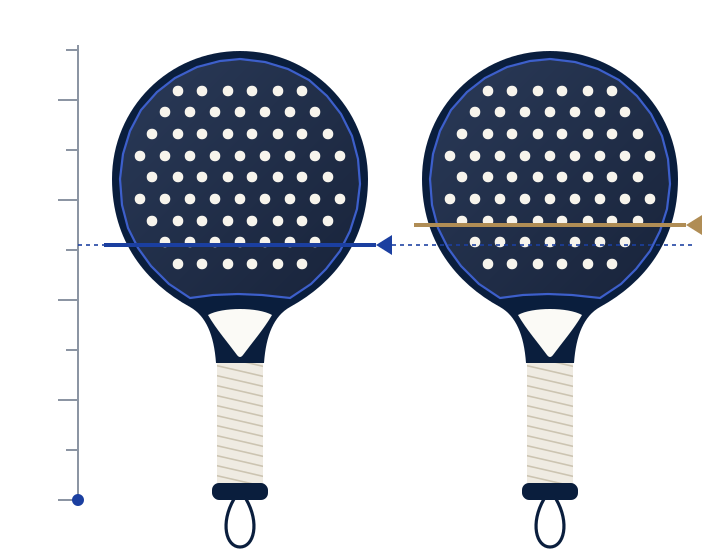
A · 360 g · 255 mmMass closer to the hand
B · 360 g · 275 mmMass further from the hand
Measure from the handle end towards the head. Both weigh 360 g; mass further out generally takes more effort to accelerate.
There is no universal boundary between low, medium and high. Different brands and retailers draw the lines differently, so what matters is comparing rackets measured the same way.
In practice you will see it described in three bands.
Low balance. Mass sits closer to your hand. The racket comes round faster and asks less of your timing. Associated with round frames and with control-oriented play.
Medium balance. The common all-round setting, and the usual home of teardrop frames.
High balance. Mass sits towards the head. More leverage on overheads, more demand on preparation. Associated with diamond frames and attacking play.
Why this matters more than total weight
The Valencia study found a strong relationship between where the balance point sits and how hard the racket is to swing, with a correlation of 0.82. Move the mass towards the head and the racket resists being swung, whatever it weighs on the scales.
Which is where the counterintuitive bit comes from. A heavier racket balanced low can move through the air more easily than a lighter racket balanced high.
Two separate things are worth keeping apart:
- How hard the racket is to swing. Mostly a matter of mass distribution. It shows up in your timing and in whether you reach the fast ball at all.
- How heavy the racket is to carry. Total weight. It shows up in your arm towards the end of a long session.
A beginner usually feels the first more. Someone playing several times a week eventually feels both.
The five performance ratings, and who needs which
For racket models covered by Padelful, PadelSwap shows five performance ratings, each scored from 1 to 10. Here is what each one means on court, and who should weight it heavily.
Rating
Power
- What it describes
- What the racket adds when you swing hard
- Where you feel it
- Smashes, heavy volleys, finishing
- Who should prioritise it
- Players who attack and already have the required technique
Rating
Control
- What it describes
- How precisely you can place the ball
- Where you feel it
- Defence, soft shots, playing off the glass
- Who should prioritise it
- Players who build points rather than end them
Rating
Rebound
- What it describes
- How readily the racket returns the ball's speed
- Where you feel it
- Lobs, the bandeja, recoveries from the back wall
- Who should prioritise it
- Anyone who spends most of their time at the back of the court
Rating
Manoeuvrability
- What it describes
- How fast you can get the racket into position
- Where you feel it
- Net exchanges, fast hands, reaction volleys
- Who should prioritise it
- Players at the net, and anyone with less arm strength
Rating
Sweet spot
- What it describes
- The size and forgiveness of the best hitting area
- Where you feel it
- Every shot you do not strike cleanly
- Who should prioritise it
- Beginners, improvers, and anyone whose contact is inconsistent
Two notes on reading these.
They are not laboratory measurements. They are drawn from manufacturer specifications, published reviews by professionals and coaches, and structured feedback from experienced players — and the site says as much itself. Treat them as well-sourced comparative judgements, which is a useful thing to have and a different thing from a measurement.
And the five are rated independently. A racket can score highly in several at once, as the Coello Pro does in power and control. You are not looking at a zero-sum budget being divided up.
Power and rebound are not the same thing
Of the five, these two get confused most often, and the confusion is expensive, because it sends people towards rackets that are harder to play with.
Power
Power describes the ceiling: what the racket gives when you give it everything.
Rebound
Rebound describes the other end. What the racket gives when you give it almost nothing.
A car has a top speed, and it has the way it pulls away from a standstill. Both appear on the same spec sheet, and for most people's everyday driving the second one matters more.
Look at our two rackets again. The Adidas rebounds at 9.5, the Head at 7.4. If your game runs largely through the back of the court, you meet that gap on every lift and every ball off the glass. The Head's extra power only appears once your technique can produce it.
Which leads to something worth saying plainly. For a player still developing, a high power rating is not simply surplus to requirements. A racket built around a committed swing often needs that swing before the ball does much at all, and that can make the whole game feel like harder work than it should.
Sweet spot: the claim and the evidence
Almost every buying guide tells you the same thing: a round racket has a large sweet spot in the middle of the face, a diamond has a small one high up. It is worth looking at what has actually been measured, because the picture is less tidy.
Researchers at the Polytechnic University of Valencia mounted 225 rackets in a cradle and used a robot to strike them along the centre line, measuring how hard the resulting vibration hit the handle. They defined the sweet spot as the point that shakes your wrist least. Where that point sat could not be predicted from the racket's shape, nor from its weight, balance or mass distribution. The authors point to differences in materials, hole patterns, the bridge at the neck of the frame and a largely manual manufacturing process as reasons why that position is hard to predict from standard specifications alone.
Position is not the same as forgiveness
One distinction matters here, and guides usually blur it. The study measured where the vibration-minimising point sits. It did not measure whether a racket is forgiving across its whole face. Those are different questions, and the sweet spot rating on a listing answers the second one.
So shape stays useful for narrowing a shortlist. It just does not settle how forgiving a particular racket turns out to be. The rating, and what people who own the model say about it, tell you more than the outline does.
One more property the specifications miss
The same laboratory also measured how much each racket resists twisting when the ball lands off-centre. That property did not track weight, balance or mass distribution around the other axes; the strongest relationship they found was 0.41.
The narrow and correct conclusion is this: the standard specification list does not describe everything about how a racket behaves. It is not that the behaviour is unknowable, only that you will not find it on a data sheet. Hitting with the racket, or reading what players who own it say, remains the most direct route.
Core and materials
The material choice you are most likely to feel is how hard the core is. Listings often describe this as the touch or feel: soft, medium or hard.
Softer cores tend to let the ball off the face more readily at lower swing speeds, and they generally feel more cushioned. Our Adidas example uses a soft EVA and rates 9.5 for rebound, which is the same story told in two different vocabularies.
Harder cores tend to give a more direct, immediate response and suit a player who hits through the ball. They ask for more from you at low speeds. The Head example is a hard-feel racket rating 7.4 for rebound.
The face is usually carbon fibre or fibreglass. Fibreglass is generally softer and more forgiving, carbon stiffer and more responsive, and many rackets mix them.
What the carbon numbers mean
You will see faces described as 3K, 12K, 18K or 24K carbon. The K is the approximate number of individual filaments in a bundle of carbon fibre: 3K is about 3,000 and 18K about 18,000. They are not a quality ranking and they do not map neatly onto stiffness. An 18K face is not automatically better than a 3K one, and the label carries more weight in marketing than it does on court.
A note on comfort
Players often ask which weight, balance or core is easier on the arm. There is no honest answer that applies to everyone. Technique, strength, how often you play and your own history all matter, and no racket specification prevents an injury. If your arm is giving you trouble, that is a conversation for a physiotherapist rather than a buying guide. What a racket can do is ask more or less of you, and that is worth factoring in alongside everything else.
Which racket suits your game
None of these is a prescription. They are starting points for narrowing a list.
If this sounds like you
Starting out.
Technique still forming, contact point inconsistent
Prioritise
Sweet spot, then manoeuvrability
- Look at
- Round or teardrop, low to medium balance, softer feel
- Worth postponing
- Anything built around power
If this sounds like you
Defensive player.
You lift, absorb and wait for the error
Prioritise
Rebound and control
- Look at
- Softer core, low to medium balance
- Worth postponing
- Hard cores that punish a soft touch
If this sounds like you
All-round recreational.
You do a bit of everything, once or twice a week
Prioritise
A balanced profile with no low outlier
- Look at
- Teardrop, medium balance, medium feel
- Worth postponing
- Specialist frames at either extreme
If this sounds like you
Aggressive player.
You come forward and finish points
Prioritise
Power, with control close behind
- Look at
- Teardrop or diamond, higher balance, harder feel
- Worth postponing
- Nothing — but be honest about whether your timing is there
If this sounds like you
Manoeuvrability first.
Fast hands at the net, or less arm strength
Prioritise
Manoeuvrability and sweet spot
- Look at
- Lower balance, lighter end of the weight range
- Worth postponing
- High balance, head-heavy frames
Your first racket is not a decision for life
If you have been playing under a year, your game will change more over the coming months than any racket will change it. The sensible goal is not the perfect racket. It is a forgiving one that lets you find out what you actually want.
That is a large part of why buying used makes sense early on. You learn what suits you on equipment that cost less to find out with.
Putting it together
A workable method, in four steps.
- 1
Pick your two. Of the five ratings, decide which two matter most for the game you actually play. Most people can do this honestly after reading the profiles above. If you cannot, choose sweet spot and manoeuvrability — those are the two that make a racket easier to play with rather than better in the right hands.
- 2
Filter on those, not on the overall score. A racket at 8.3 that is strong where you need it will serve you better than an 8.7 that is strong somewhere else.
- 3
Compare profiles side by side. Two rackets on the same total can be opposites, as our opening pair shows. Lay the five numbers next to each other and the difference is obvious in seconds.
- 4
Then check the individual racket. Which is a different job.
One caveat before you buy
Everything above describes a model. Ratings and specifications are written about a racket as it leaves the factory.
A used racket is a particular object with a history. The previous owner's overgrip and protector have shifted its weight and balance, and the core may not behave quite as it did when new. None of that makes a used racket a bad buy, but it does mean the model's numbers are the start of the assessment rather than the end of it.
Read also→ Thinking of buying used? Here is what to check before you buy.Not sure which racket suits you?
Tell us your level, what you want more of from a racket and your budget, and we will narrow the field to the models that fit.
Find a racket that fits →Common questions
Is a round racket always the best choice for a beginner?
No, though it is a reasonable starting point. Round frames tend to carry their mass lower and tolerate an imperfect contact point better. But shape alone does not settle it — check the weight, the balance and how hard the core is before deciding.
Does a higher overall rating mean a better racket for me?
No. The overall figure is the average of five attributes, calculated on behalf of an average player. Two rackets with the same score can be opposites, as the pair at the top of this article shows. Read the profile rather than the number.
Is 18K carbon better than 3K?
No. The K is the approximate number of filaments in a bundle of carbon fibre — 3K about 3,000, 18K about 18,000. The number alone does not determine the quality or the stiffness of the face, and it carries more weight in marketing than it does on court.
What should I prioritise if I do not know my style yet?
Sweet spot first, manoeuvrability second. Those two make a racket easier to play with rather than better in the right hands, and you can work the rest out after a few months on court.
Sources
Weight, balance and mass distribution measurements, and the player trial, come from a study of 137 rackets at the Polytechnic University of Valencia: Identifying the Inertial Properties of a Padel Racket, Sensors 2022.
The robotic sweet spot measurements across 225 rackets come from the same laboratory: Identifying the Sweet Spot of Padel Rackets with a Robot, Sensors 2023. Both studies draw on the Testea Padel laboratory, so they are one research group rather than two independent sources.
The five attribute definitions and the formula behind the overall rating come from Padelful's methodology page. The individual scores quoted are from the Adidas Metalbone CTRL 3.4 2025 and Head Coello Pro 2026 model pages, checked on 10 October 2026.
Full research citations
- Blanes, C.; Correcher, A.; Beltrán, P.; Mellado, M. Identifying the Inertial Properties of a Padel Racket: An Experimental Maneuverability Proposal. Sensors 2022, 22(23), 9266.
- Blanes, C.; Correcher, A.; Martínez-Turégano, J.; Ricolfe-Viala, C. Identifying the Sweet Spot of Padel Rackets with a Robot. Sensors 2023, 23(24), 9908.