Buying a used padel racket: what to check before you buy
12 min readSources ↓
A used racket is one object with a history, not a model out of a catalogue. Everything below is about telling the difference between a racket that has been played and a racket that has been used up.
Look closer at the object
Four places to inspect on a racket
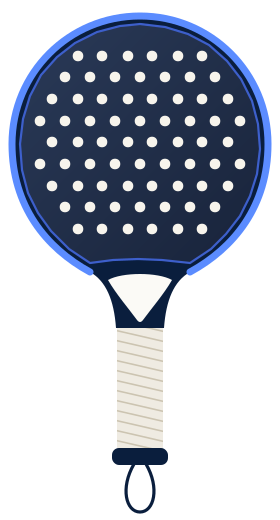
1. Frame edge
Ask for the edge photo. A protector can hide marks.
2. Face
Look at the surface; a photo cannot show a soft area.
3. Handle
Check the grip and added overgrips.
4. Wrist strap
Look for wear and fraying.
Wear and structural damage are different. Photos can prompt a question; they cannot establish a diagnosis.
In this guide
Why buying used makes sense
The obvious reason is price, but it is not the most interesting one.
You can reach better equipment. A racket that was a flagship two seasons ago is still a well-made racket. Buying it used puts a level of construction within reach that you would otherwise skip past.
You can afford to be wrong. This matters most early on. Until you have played for a while you do not really know whether you want a forgiving frame or a demanding one, and the honest way to find out is to play with something and notice what annoys you. Doing that on a used racket costs less, and if it turns out to be the wrong choice you can pass it on rather than live with it. How much you recover depends on the model, its condition and what the market looks like when you sell — nobody can promise you a figure.
It keeps good equipment in play. A racket with life left in it is better used than forgotten in a cupboard. A second owner extends how long it stays in service, and may mean one fewer new racket bought. That is a modest argument rather than a dramatic one.
The case against is simpler: you are buying something you cannot hit with first, from someone you do not know. The rest of this guide is about closing that gap.
You are not buying a model. You are buying one object.
This is the single idea worth taking away.
When you read a racket's specifications or its performance ratings, you are reading a description of a model as it left the factory. A used racket has been somewhere since then.
Three layers are worth keeping apart.
- 1
Manufacturer specifications describe the model in general. Even that is looser than it looks: some manufacturers publish weight as a range up to 20 grams wide, so two examples of the same model can differ by more than two different models appear to differ on paper.
- 2
Performance ratings describe how the model plays, compiled from specifications, professional reviews and player feedback. They are a good comparative guide to a model. They are not a measurement of the particular racket in the photographs.
- 3
The seller's photos and description are the only part that is about the actual object.
Does a used racket still play like its ratings? Often, roughly, yes. But laboratory testing at Testea, which ages rackets by striking them repeatedly, found that some rackets change stiffness noticeably with use, and stiffness affects both power and feel. A heavily played racket is not guaranteed to behave the way the model page says.
Read alsoNot sure which model you are even looking for yet? Start with the guide to choosing a racket and come back here.Wear that matters, and wear that does not
Most used rackets look worse than they play. The job is to separate marks from damage.
Usually cosmetic
Minor paint chips, light scuffs along the frame edge and ordinary grip wear are normal on a racket that has been played, as is some loss of texture on the face. How much any of it matters depends on how severe it is and where it sits, but in the ordinary case none of this changes how the racket plays in a way you are likely to notice.
Worth a closer look
Cracks in the frame. The thing to examine is the edge of the frame, which is why we ask sellers to photograph it. A crack can run along the side of the frame where a protector would normally hide it. Hairline marks in the paint are not the same as a crack in the structure, and photographs do not always let you tell the difference — if you are unsure, ask.
Delamination. The face separating from the core underneath. It can show up as a soft area, or as a change in the sound of the face. Some players tap across the surface and listen for an inconsistent note. That can flag something worth asking about, but it is not a reliable test of structural integrity — different constructions sound different even when nothing is wrong. Treat it as a reason to ask a question, not as a diagnosis.
A tired core. The EVA inside compresses over years of play. The racket does not break; it goes flat, giving less back and feeling duller. This is the hardest thing to judge remotely, and the main reason to ask how long and how hard a racket has been played.
Previous repairs. Always ask whether the racket has been repaired, and why. A cosmetic repair is usually not a problem. Structural damage is a different matter: a cracked frame or a separating core can affect both performance and safety even after the visible damage has been covered. Rackets with that kind of damage are not permitted on PadelSwap at any price, so a low figure does not make such a listing acceptable.
The wrist strap. Small, but required equipment, and a frayed one tells you something about how the racket has been treated.
Photographs help, and they do not show everything. No set of pictures proves that a racket is structurally sound. If something looks or sounds off, ask the seller before you buy rather than after — and if you believe a listing shows a cracked frame or a separating core, tell us, because those are not allowed here.
The specifications have already moved
Here is something buyers rarely think about, and it is the most practical insight in this guide.
Almost every racket in use has an overgrip wrapped around the handle, and many have a protector along the top of the frame. Both add mass, and they add it at opposite ends.
An overgrip sits at the handle, which pulls the balance point down towards your hand and makes the racket a little easier to swing. A protector sits at the head, which pushes the balance up and makes the racket feel heavier through the stroke. Two or three overgrips stacked up, which is common, shift things further.
Same racket. Different setup.
Schematic
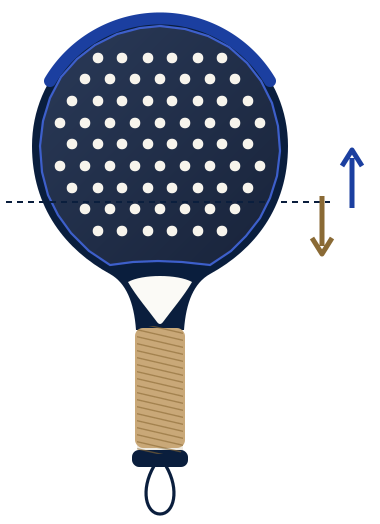
- Overgrip
- Frame protector
- Balance point without accessories
An overgrip adds mass at the handle; a protector adds it at the head. The diagram shows the direction of the balance shift, without assuming added mass.
The researchers who measured 137 rackets list added grips and protectors separately as a factor that interfered with their measurements. It is a real effect, not a rounding error.
So when you compare a used racket against the manufacturer's published weight, you are comparing two different things: a bare racket on paper against a set-up racket in someone's bag. Ask what has been added — how many overgrips, whether there is a protector, anything else. And if the seller has scales to hand, ask what it actually weighs as it stands. Not every seller will, and it is still worth asking.
If the racket arrives feeling different from what you expected, the grip and the protector are the first things to look at — and both are easy to change.
What to ask the seller
Five questions that tell you more than any photograph.
- 1
How long have you played with it, and how often?
A racket used twice a week for three years has had a different life from one used fortnightly for one.
- 2
Has the frame ever taken a knock, and has anything been repaired?
Ask directly. Most sellers answer honestly when asked directly.
- 3
What has been added to it, and what does it weigh as it stands?
How many overgrips, whether the protector is original. The weight only if the seller has scales — plenty will not, and the first half of the question matters more.
- 4
Is there anything about the racket that feels or sounds unusual?
A soft patch, a dull note somewhere on the face, a rattle. You are asking the seller to describe, not to diagnose.
- 5
Why are you selling it?
The answers are usually mundane — moved to a different model, stopped playing, got two as a gift. An evasive answer is itself information.
None of these is rude, and none of them should offend a seller with nothing to hide. A good seller tends to welcome them, because they mark out a buyer who is serious rather than one who will complain later.
Price and value
The cheapest listing is not the best deal, and the most expensive is not the safest.
Four things move what a used racket is actually worth.
Age of the model. Not the age of the object. Manufacturers release new versions annually, and a two-year-old model drops in price mainly because it is no longer current, not because it has stopped working.
Condition, honestly described. A racket with a documented knock priced accordingly is a better buy than a mint-looking one with a vague description.
Scarcity. Some models hold value because people want them and few come up. Others sit because nobody is looking for them.
What else is available. An asking price only means something next to the alternatives — other used listings this week, and comparable rackets in the same budget.
And compare today's prices, not yesterday's price tag. Brands release new versions regularly and retailers discount the outgoing ones hard. A racket that launched at a high price may now be available new for considerably less, which makes a used asking price look better than it is. Check what the same model costs new today, then against other used listings, then against comparable alternatives in your budget. The original retail price tells you what the racket once cost. It says nothing about what a fair used price is now.
A practical way to think about it: a racket you will play with twice a week for a year costs you very little per session even at the top of the used range. A racket you stop using after a month was expensive whatever you paid.
Reading a listing
A PadelSwap listing carries three kinds of information and they deserve different levels of trust.
Model data
shape, weight, balance, core and face material. Accurate about the model, silent about this particular racket.
Performance ratings
the five scores compiled by Padelful from manufacturer specifications, professional reviews and player feedback. A sound comparative guide to how the model plays. Not a laboratory measurement, and not a statement about the object in the photos.
Seller photos and description
the only part about the actual racket, and therefore the part to read most carefully.
Our listing rules exist to make that third part usable. Sellers must photograph the front, the back, the edge of the frame and the wrist strap, and describe wear, the condition of the core and the state of the face. The frame edge is the photograph people skip past, and it deserves a closer look: dents, cracks and other signs of impact are easy to miss in pictures of the face alone.
If a listing is missing those photos, ask for them before you buy rather than after.
What buyer protection covers
Worth being precise about, because this is where expectations drift.
Payments run through Stripe, so the seller does not receive your money when you pay. It is held until you have the racket and the inspection window has closed.
After it arrives you have 48 hours to check it and report anything that differs materially from the listing. Buyer protection also provides help when an order does not arrive, or when a transaction cannot be completed in the ordinary way. Buyer protection does not cover damage that happens in transit: that claim goes directly to the carrier.
What it does not offer is a general right to return a racket that is exactly as described but does not suit your game. Buying from a private seller and buying from a trader are different: with a trader, statutory consumer rights including a 14-day right of withdrawal may apply.
That is the honest reason to do the work before you buy rather than after.
The full terms are on the how it works page and in our terms of service.
The checklist
Before you buy:
After it arrives, within 48 hours:
Ready to look?
Browse used rackets on PadelSwap →Common questions
Is buying a used racket risky?
Two risks matter most on the equipment side: structural damage, and a core that has gone flat with age. Both are manageable: ask for a photograph of the frame edge, ask how long and how often the racket was played, and ask whether it has ever been repaired. Rackets with frame cracks or a separating core are not allowed on PadelSwap at all.
What if it turns out not to suit my game?
Buyer protection does not cover that. It covers an item that does not arrive, one that differs materially from the listing, and a transaction that cannot be completed in the ordinary way. A racket that is exactly as described but wrong for you is not a fault. The practical answer is that buying used makes experimenting less expensive. If the model turns out to be wrong for you, you can offer it on, though what you recover depends on its condition and on demand.
Can I tell from photographs whether a racket is sound?
Not entirely. Good photographs of the front, back, frame edge and wrist strap will show most visible damage, and they will not reveal everything inside the frame. If something looks or sounds off, ask before you buy.
Does a used racket still play like its ratings?
Usually roughly, but not exactly. The ratings describe a new model. Added overgrips and a frame protector shift the weight and balance, and laboratory testing has found that some rackets change stiffness noticeably with use.
Sources
The effect of added grips and protectors on weight and balance, and the manufacturer weight ranges, come from a study of 137 rackets at the Polytechnic University of Valencia: Identifying the Inertial Properties of a Padel Racket, Sensors 2022.
The finding that some rackets change stiffness with use comes from laboratory testing by Testea, reported via Testfakta.
Platform rules are from our own terms of service, sections 6.2 and 7.2, and the how it works page.
Full research citations
- Blanes, C.; Correcher, A.; Beltrán, P.; Mellado, M. Identifying the Inertial Properties of a Padel Racket: An Experimental Maneuverability Proposal. Sensors 2022, 22(23), 9266.